

I'm The Exhausted Moderate
Join me on the journey from partisan hype to facts and sense.
Let Me Tell You Who I Am
I’m a moderate. Not a centrist by default, not someone who can’t make up his mind, and not someone too timid to hold a conviction. I’m a moderate because I’ve thought hard about the issues, I’ve looked at the data, and I’ve reached conclusions that don’t fit neatly into either party’s talking points. That used to feel like a reasonable place to stand. Lately, it feels like standing in a war zone with both sides shooting in your direction.
I grew up in Texas. I voted Republican my entire life, right up until the Obama years, because at my core I remain what I’ve always been: fiscally conservative. I believe in low taxation. I believe in limited government. I believe in personal accountability. These aren’t bumper stickers for me — they’re a philosophy I’ve lived by, a set of principles I can actually defend with evidence.
I also served in the military. I want to say that plainly, because it matters to everything that follows. Serving is the ultimate act of love for your country — the willingness to put your life on the line for something larger than yourself. I understood that when I signed up, and I still understand it now. The men and women who wear the uniform are among the truest patriots this country produces, and I say that not as a talking point but as someone who was one of them.
But I’m also a man with eyes. And what I’ve watched happen to the Republican Party over my lifetime — and what I’m watching happen to the military right now — has left me politically homeless, genuinely alarmed, and, frankly, heartbroken.
The Slow Transformation I Watched and Couldn’t Stop
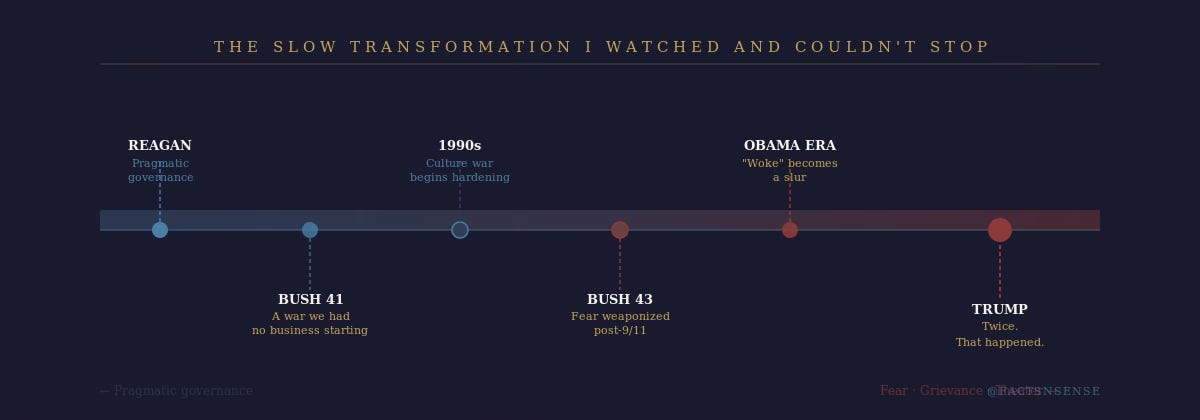
It didn’t happen overnight. The party I grew up with began shifting with Bush 41 and a war I believed then, and still believe now, we had no business starting. I watched as the GOP I knew — the party of pragmatic governance, of Eisenhower’s infrastructure and Reagan’s negotiation — gradually surrendered to something darker: a politics of fear, of cultural grievance, of a desperate clinging to a version of America that my grandparents’ generation once defended with the phrase “separate but equal.”
I watched conservatives grow increasingly afraid. Not afraid of real threats, but afraid of social change, afraid of a country that was evolving — becoming more diverse, more connected, more complicated. And that fear hardened into something weaponized. “Woke” became a slur that people I thought were friends used the way my grandparents used words for people of color that I won’t repeat here. The pattern was the same: take a thing you fear, give it a name, and use that name to make fear feel like righteousness.
That fear, amplified by social media and cable news echo chambers, became powerful enough to put Donald Trump in the White House. Not once. Twice. With only a four-year break occupied by a president who, whatever his virtues, visibly struggled under the weight of the office.
And I’ve watched people I’ve known my whole life — smart people, decent people — shut their ears, retrench in fear, and refuse to look at what’s actually happening. That’s where my exhaustion begins.
What the Military Taught Me About the World
Serving gave me something Texas hadn’t: a view of the world beyond its borders. When you put on a uniform and serve overseas, you stop seeing the world as a map centered on your hometown. You start seeing it as a system of relationships — complicated, ancient, and not waiting around for American certainty to catch up.
I walked through the ruins of Rome. I stood on the streets of Paris. I encountered civilizations that were old when America was still an idea in someone’s journal. And what struck me, standing in all of that history, was how young we are — and how much we behave like it. The American view of the world, for all its genuine idealism and power, carries a certain naivety that older nations see immediately and that we rarely acknowledge in ourselves.
What I learned from those experiences is something I’ve never stopped believing: we cannot save the world alone. We need our allies, our partners, the whole complicated ecosystem of relationships that took decades to build. And that means compromise. It means accepting that not every agreement will go our way. It means treating our partners as partners — not as dependents, not as subordinates — because a world organized around American dominance rather than shared interest is a world that will eventually push back. Hard.
That’s not weakness. That’s strategy. And it’s something every military officer understands from the first moment they sit in a room with allies from a dozen different nations and have to find a common objective. The problem is that the politicians who deploy the military often seem to have missed that lesson entirely.
Serving overseas also did something more personal: it cracked open my sense of what this world actually is. Seeing it from the outside — seeing America as others see it, with its extraordinary promise and its stunning contradictions — made me want to keep seeing. It lit a fire for travel that has taken me to places I never imagined standing as a kid in Texas: the foot of the Great Pyramids at Giza, the banks of the Mara River in Kenya watching thousands of wildebeest cross in the annual migration that has been happening on that plain for longer than human memory. Standing in those places does something to a person. It makes you small in the best possible way. It reminds you that this is our world — all of us — and that we are all in it together, with very different points of view, different histories, different wounds, and different hopes. And that we had better start acting like it, because we are overpopulating and polluting this little blue ball we live on, and nobody gets to opt out of the consequences.
The Screaming Into the Void Years
I’m an analyst by trade. I’ve spent my career sourcing data, sifting facts, and telling people what the facts actually mean — not what people wish they meant, not what fits the narrative, but what the evidence actually shows. It’s a discipline I take seriously.
So when I looked at what was happening in this country with as much objectivity as I could muster, I couldn’t stay quiet. For years I argued, debated, shared data, wrote long emails, posted on social media. I tried to remind people that they were decent, and that the facts simply did not support the direction we were heading. I thought if I just found the right argument, the right data point, the right framing, something would break through.
It didn’t. And eventually, the energy I was spending trying to change minds I couldn’t reach became exhaustion. Pure, bone-deep exhaustion. I know what it’s like to scream facts into a void and watch them disappear.
Let Me Be Clear About What I Actually Believe
Here’s the thing that makes me a moderate rather than just a disaffected Democrat: some of what conservatives want, on paper, makes sense to me. I want safety. I want criminals who are here illegally to face consequences, including deportation. I don’t believe in a welfare state that removes personal accountability. I want low taxation. I want our allies to be genuine partners who carry their fair share of the financial burden of protecting the free world — because I served in that mission and I understand what it costs and what it’s worth.
But what I’m watching isn’t the pursuit of those goals. It’s something else entirely. It’s theater. It’s cruelty dressed up as strength. It’s the abandonment of process, law, and basic decency in the name of “getting things done.” And I refuse to pretend that the ends justify these means, because the facts don’t support that they’re even achieving the ends.
My life has also taken me a long way from the Texas I grew up in — and I mean that in the best possible sense. I ended up in California, which is about as far politically from my home state as you can get. And I have been married for going on thirty years to a woman whose East Coast roots brought into our life together something I hadn’t had enough of: a genuine, grounded belief in socially progressive ideas.
Through her eyes, and through thirty years of building a life together, I’ve come to understand some things I didn’t grow up knowing. That the right to love and marry whoever you love — and to enjoy the full legal dignity that comes with that — is not a political talking point. It’s a human one. That how a person identifies sexually is not a moral failing, not a corruption, not a sin — it is simply who they are. That when you look honestly at the facts and the history, the white majority in this country has a long, well-documented record of exploiting people of color, and that I — however much I hope I’ve grown beyond the reflexes of the culture I was raised in — have benefited from that system. And that benefiting from an unjust system, even unknowingly, comes with a responsibility to look at it clearly.
I want to do something about that. I’m just not entirely sure what. And I’ll be honest about something uncomfortable: my efforts to be an ally — to show up, to listen, to advocate — have sometimes been met with the same kind of reflexive bias from people of color that they accuse me of carrying. That stings. And it’s exhausting in its own particular way. Not because I think the exhaustion is equal, or the stakes are the same — they are not — but because it makes the path forward harder to see. I’m still on it. I just don’t always know where it leads.
That’s what it means to be in the middle, honestly. You carry contradictions. You don’t get the comfort of the pure position.
The 2020s Have Been a Lot
Let’s be honest: this decade has been brutal. A global pandemic. The inflation that followed. The social upheaval. And then, as if watching a man unleash a mob on the United States Capitol and do nothing about it wasn’t disqualifying enough, we watched that same man get re-elected and, on day one, pardon the criminals who tried to overturn our democracy. I still can’t fully process that sentence.
Now I’m exhausted by war and by what can only be described as strategic incompetence on the world stage. When an administration rebrands the Department of Defense to the “Department of War,” that’s not just optics — that’s a signal. And as someone who served in that institution, who knows what it was built for and what it means, watching it get renamed and repurposed for political theater is not an abstraction to me. It is personal.
First came adventurism in Venezuela. Now there’s talk of boots on the ground to secure nuclear facilities in Iran — one of the oldest civilizations on earth, a nation with deep and complex history, legitimate grievances alongside genuine hostility. I’ve stood in ancient places. I’ve walked through history that predates the United States by millennia. I know what it feels like to be a guest inside a story much older than your own. And I can tell you with confidence: bombing and invading Iran will not install peace and democracy. It will add another chapter to a very long book that doesn’t end the way we keep hoping it will.
You don’t need a Master’s degree in Middle Eastern Studies to understand that. You need exactly two things: a belief in the facts, and a little common sense. Those two things, I’ve found, are in shorter supply than they should be.
Why @factsnsense — And Why Now
So here’s what I’m doing about it. I’m done screaming into the void. I’m channeling everything I know how to do — analyze data, cut through noise, and write clearly — into something that might actually matter: raising awareness of what the facts actually are.
The truth is out there. It’s buried under an avalanche of partisan coverage, ideological framing, and social media outrage. But if you’re willing to sift through it — to set aside the narrative, follow the evidence, and apply some common sense — it’s findable. I’ve developed a method for doing exactly that: scoring claims for what we know for certain, what appears likely, and what remains speculative. And I’m going to show my work. Every time. I’ll provide the receipts.
This isn’t a left-wing publication. It isn’t a right-wing one. It’s something rarer: an honest one
You’re Not Alone
I believe there are millions of people like me scattered across the political spectrum. Independent thinkers. People who want the facts and trust themselves to draw their own conclusions. People who have done enough living to know that the world is complicated, that good intentions don’t automatically produce good policy, that the truth is usually somewhere in the middle of two loud, wrong extremes.
People who served, or love someone who served, and feel something cold move through them when they watch that service get exploited.
People who have been changed by the world — by travel, by marriage, by the slow expansion of who they know and love and are responsible for — and who find that their politics can no longer fit inside the box they started in.
People who carry contradictions and have stopped apologizing for it.
We are the exhausted moderates. We’ve been drowned out by the loudest voices on both ends, dismissed by pundits who profit from conflict, and abandoned by a political system optimized for outrage rather than governance. But we’re here. And I think, if enough of us find each other, we can do something.
Not the impossible thing — not perfect unity, not an end to disagreement. The achievable thing: influence. The power to remind people that there is a middle ground where peace and prosperity actually live. The ability to vote for common-sense government and to encourage others to do the same. The courage to say, loudly and with evidence, that this is not the way — and here’s what the data says instead.
I’m Brian Hopkins. I’m The Exhausted Moderate.
I wept as I wrote this. Welcome to @factsnsense.
Let’s find out what’s actually true — together.
Thanks for the share!